Direct answer
Dynasty Blueprint is College Football 27's annual program budget system. Dynasty Points fund coaching staff, facilities, Recruiting NIL, and Roster NIL, and unused points do not carry into the next year. Read your three active Athletic Director goals first, protect hard-to-replace roster resources, and spend by the mode's calendar. There is no universal best allocation; the plan should match your school, roster, staff, and job-security pressure.
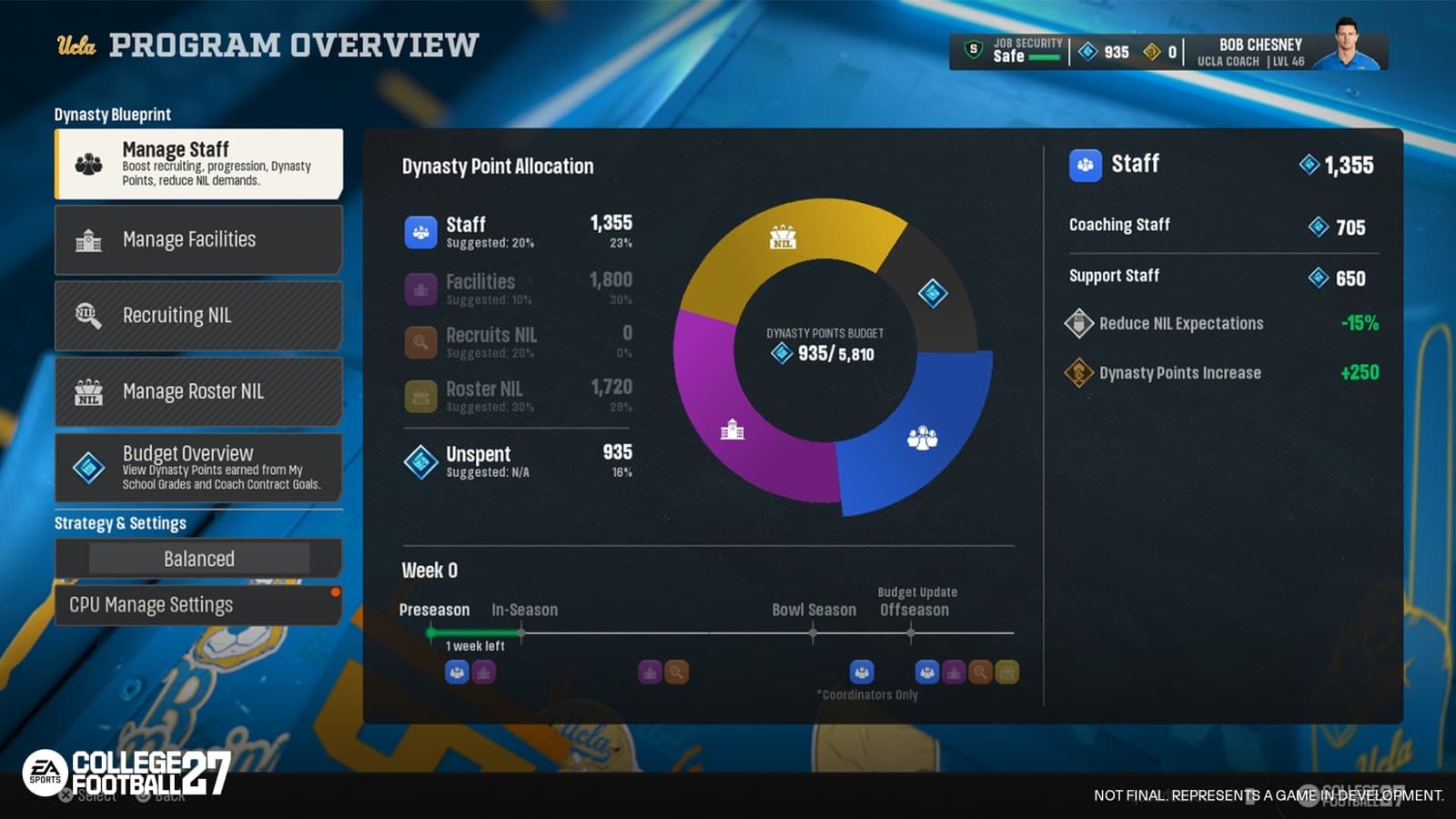
Official Dynasty Blueprint capture showing the program-budget categories and season timeline; the displayed sample values are illustrative. Official pre-release development capture; the live interface may differ.
Merged Dynasty Points workflow · S3 / S15
Spend by the Dynasty calendar
Dynasty Points do not roll into the next annual pool, but availability changes by stage. Review the live league screen before committing resources.
- 01Preseason
Support staff, equipment, scouting, and active Athletic Director goals.
- 02Regular season
Recruiting NIL and scholarships from Week 0; keep roster and facilities in view.
- 03Bowl season
Coordinator carousel and ordered offers.
- 04End of Season Recap
Budget refresh, payouts, facilities, transfers, and roster retention converge.
Understand the budget before choosing a strategy
EA defines Dynasty Points as the yearly currency behind Dynasty Blueprint. The budget refreshes during the End of Season Recap, and the new amount is influenced by school grades including Conference Prestige, Brand Exposure, Stadium Atmosphere, and Program Tradition. Major accomplishments, postseason results, and some Athletic Director goals can add payouts during that refresh. The crucial restriction is simple: Dynasty Points do not roll over from one year to the next. Saving points forever is therefore not a long-term development strategy.
Our recommendation is to think in commitments rather than percentages. First list unavoidable costs, such as facility maintenance or priority retention. Next list high-value opportunities, such as a coordinator hire or a recruit who fills a genuine need. Only then consider optional upgrades. This is a planning suggestion, not an official formula, but it helps prevent an early purchase from consuming points needed later.
- Confirmed rule: the annual budget refreshes at End of Season Recap.
- Confirmed rule: unused Dynasty Points do not carry over.
- Suggested habit: separate commitments, opportunities, and optional spending.
Turn Athletic Director expectations into priorities
Every school has three active Athletic Director goals, and performance against those goals affects job security. Schools also have different demeanors. A patient program gives a longer runway, while an impatient or reactionary program can respond more sharply to missed priorities. Goals can cover championships, rivalry results, statistical benchmarks, recruiting territory, facilities, rankings, and sustained performance. Some are single-season goals and others can span multiple seasons, so a successful year is not judged by one generic win total.
Before allocating points, our suggested audit is to label each goal by deadline, job-security impact, and the program system it depends on. A recruiting-territory goal may justify extra recruiting resources; a facilities goal can force an offseason commitment; a rivalry or statistical goal may make staff fit more urgent. Do not assume a stretch goal deserves the same budget protection as a firm expectation. That distinction is visible in the mode, and using it as a priority filter keeps the Blueprint connected to how your specific job is evaluated.

Anonymous markers visualize a recommended planning workflow, not real recruits, rankings, or schools.
Build a staff that covers the program's real gaps
Coaching staff is one of the major Blueprint spending areas. Head coaches manage coordinators and support staff, while user-controlled coordinators do not manage support staff or hire coordinators. Support staff are handled in preseason and then lock for the season. Their available slots are tied to Team Prestige, with one slot per prestige level up to five. Staff effects can support recruiting hours, offseason progression, NIL expectations, fundraising, or the cost of other hires, and higher staff tiers cost more points for stronger effects.
Our recommendation is to buy an effect because it solves a named constraint, not because its tier looks impressive. A small program with limited slots may need one focused benefit more than several loosely related ones. For coordinators, compare abilities and fit before increasing the offer. A free-agent fallback can fill an opening for zero Dynasty Points, though EA describes those coaches as generally less experienced and less powerful. Keep a fallback so one missed hire does not force an overspend.
Treat facilities as a multi-year commitment
Facilities influence the Athletic Facilities grade and player progression. EA separates the system into a facility tier and equipment. The tier sets the grade range and the number of equipment slots, while equipment can improve the grade within that range or provide temporary benefits such as reducing practice Wear and Tear, season health usage, or practice injury chance. Facility changes occur during End of Season Recap, and an upgrade remains under construction through the offseason before becoming available in the following preseason.
A higher tier also has a higher annual maintenance cost. If the cost is not paid, the facility drops one tier; a voluntary downgrade can likewise free points for other Blueprint areas. Our suggested decision test is to count more than the purchase price. Ask whether you can maintain the tier next year, whether its development benefit matches the age of your roster, and what NIL or staffing choices the upgrade displaces. Equipment is the more flexible choice when you need a targeted seasonal effect without raising the program's permanent maintenance burden.
Separate Recruiting NIL from Roster NIL
NIL has two distinct jobs in Dynasty Blueprint. Recruiting NIL helps compete for high school prospects and transfers; Roster NIL helps retain players already in the program. Each recruit and roster player has an expected amount based on factors described by EA, and an aggressive offer can establish a higher expectation that follows the player. Recruiting offers begin in Week 0 after a preseason focused on scouting. Points attached to an offer are deducted immediately, then refunded if the recruit chooses another school or is removed from the board.
Roster NIL is adjusted during End of Season Recap. Raising an offer can reduce a player's risk of leaving, while reducing it can increase that risk. Because the same annual pool also supports staff and facilities, our recommendation is to create a short retention list before chasing transfer or high school targets. Rank players by replacement difficulty and future role, then compare that list with the recruits who fill actual needs. This is a suggested roster-building method, not an EA-mandated ranking. Its purpose is to expose the real tradeoff between acquiring one more prospect and keeping proven talent.
Spend according to the Dynasty calendar
Blueprint actions open at different points of the year. Preseason is when support staff can be hired or fired and equipment can be purchased. During the regular season, equipment remains available and Recruiting NIL supports high school recruiting. Bowl season centers on the coaching carousel and coordinator management; support staff changes are unavailable then. The offseason includes the budget refresh, performance payouts, major facility upgrades, transfer recruiting, and roster retention decisions.
Our suggested discipline is to leave every stage with a written next-stage obligation. Before leaving preseason, note points committed to staff and recruiting. During the season, do not treat the visible balance as disposable when coordinator, facility, or retention decisions are coming. Before End of Season Recap, review roster risk and intended facility actions. A reserve is useful only with a named purpose; because points expire, allocate an unnamed reserve before the refresh.
Use a repeatable annual Blueprint checklist
A repeatable process makes different schools comparable without pretending they need the same allocation. At the start of each year, record the three active goals, school demeanor, baseline budget drivers, current facilities, staff slots, and major roster risks. At each stage, update only the decisions that the calendar makes available. At season end, compare what created value with what merely consumed budget. EA also provides Blueprint Strategies that show suggested spending allocations, but those strategies do not automatically spend points; the final decisions remain yours.
The sequence below is our recommended control loop. Reuse it after a job change, when inherited NIL commitments and a new school identity can invalidate the previous plan. A sound Blueprint can explain every major expense through an expectation, roster need, or durable program advantage.
- Write down all active goals, deadlines, and job-security stakes.
- Reserve points for essential maintenance and priority retention decisions.
- Match staff, facility, and recruiting investments to specific weaknesses.
- Recheck commitments before every calendar advance that opens a new spending stage.
- Spend remaining points intentionally before the annual use-it-or-lose-it refresh.