Direct answer
Road to Glory follows one student-athlete from player creation and high school tape through recruiting, college development, Draft Projection, and Legacy Score. Build around a clear positional identity, choose a school by role and annual scholarship benefits rather than name alone, and protect Fitness, Academics, Leadership, and Brand while earning progression through practice and games. Those priorities are our recommended approach; EA's confirmed systems make each choice consequential, but they do not prescribe one perfect career path.
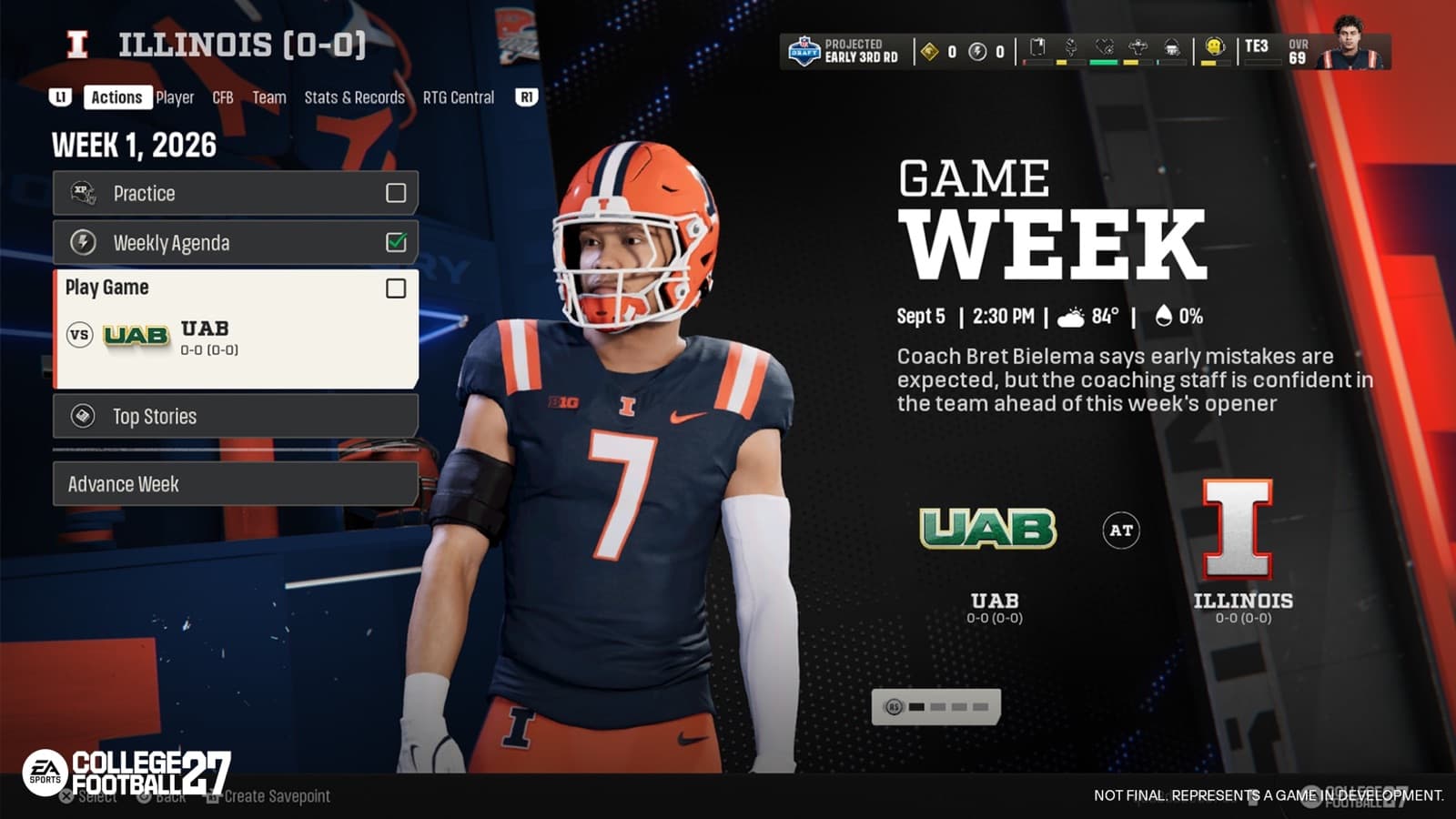
Official Road to Glory weekly-loop capture; the sample athlete, opponent, date, weather, and ratings are illustrative. Official pre-release development capture; the live interface may differ.
Create the ceiling before chasing the rating
College Football 27 offers two creation paths: build a custom athlete from the ground up or begin with a Legend Template. A custom player lets you choose height, weight, body type, physique-driven attribute caps, and Max Potential allocation. Position determines the available height range; height affects the weight range; weight affects available body types. The interface updates physical caps as those choices change, so physique defines what is physically possible before development begins.
Max Potential is a separate layer. It determines the developmental ceiling you can actually reach inside the physical limits of the build. Custom attributes begin from a base value and consume a shared pool as you raise their potential, with elite ratings costing more. Legend Templates arrive with preset measurements, physique caps, and potential allocations, but still allow some reallocation. Our recommendation is to define two or three identity attributes first, then inspect the final summary for meaningful weaknesses instead of trying to make every category equally strong.
Use high school to build useful tape
The high school phase contains five games with four playable moments in each game. Before each game, you choose moments based on the situation and the schools evaluating you. Objectives are connected to position, archetype, and game context. Completing them earns Tape Score, while broader Team Impacts can also credit explosive or game-changing plays that are not part of the listed objective. Highlight Moments can include multiple objectives and award partial progress instead of functioning only as pass or fail.
Our suggested approach is to favor moments that both suit the build and matter to schools you would genuinely consider. Read the situation before forcing the headline play: protecting a lead, changing field position, or executing a position mechanic can be the correct objective even when it produces a modest box-score line. When a Highlight Moment has several targets, secure the achievable part before taking a low-percentage risk. This is strategy advice, not a guaranteed Tape Score formula; the official system evaluates objectives and total impact together.
Compare scholarship offers as annual development packages
Recruiting screens show scholarship bonuses across Academics, Leadership, Brand, Fitness, Coach Trust, and Skill Points, along with information such as projected depth-chart position. Those bonuses are annual. At each season's end, the school evaluates the player again and can change the next offer according to performance, development, responsibilities, and standing with the program. Signing Day narrows the decision to a Top 3 before the final selection.
Because the offer continues to matter after freshman year, our recommendation is to compare three things: the path to meaningful snaps, the bonuses that support your build's weak meters, and the standard you can realistically maintain. A prestige label cannot replace role fit. A program with a clearer depth-chart opportunity may produce more chances to earn on-field grades, while a stronger Fitness or Academics package may reduce pressure elsewhere in the weekly plan. This is a decision framework, not an official ranking of schools.
Protect Fitness and the meters behind Mental Abilities
Weekly Agenda controls life away from gameday, including academics, leadership, brand, health, recovery, and fitness. Fitness now affects Coach Happiness, progression speed, body changes, and temporary boosts or penalties to important attributes. Reaching peak condition can provide benefits, but maintaining it requires a substantial weekly energy commitment. Allowing Fitness to fall can slow progression and make the recovery climb more expensive than routine maintenance.
Creation also includes three starting Mental Abilities tied to Academics, Leadership, and Brand. An ability can deactivate when its connected meter falls below the required level, then return after the meter is restored. Our recommendation is to treat each active ability as a weekly service cost: know which meter powers it and decide whether its gameplay value justifies the energy. Protect Academics from eligibility problems, maintain enough Fitness to avoid a recovery spiral, and rotate discretionary energy among Leadership and Brand according to the career goal.
Make practice and per-play grading work together
Practice is the main off-game route to progression rather than a direct Weekly Agenda training purchase. EA says the mode includes more than 50 new drills across team situations and position-specific work. The medal earned in the assigned weekly drill affects XP, Coach Trust, and Coach Happiness. That matters both for a reserve fighting for a larger role and for a starter trying to keep developing.
Gameday uses rebuilt per-play grading focused more closely on the user's own action. Correct reads, assignment execution, pressure, tackles, blocks, and work in space can be recognized even when the team result does not tell the full story. Our suggested loop is to use practice to learn the exact mechanic a position grade rewards, then value assignment-correct snaps over constant highlight attempts. When a grade drops, identify the action behind it and take the next clean rep instead of changing the entire career plan after one mistake.
Progress toward Max Potential, Legacy, and Cap Breakers
XP from practice and games produces Skill Points, which upgrade individual attributes up to their Max Potential caps. Costs depend on the attribute's positional importance, current rating, and the player's measurements. Physical Abilities also have attribute requirements. Separately, Legacy Score reflects performance, accomplishments, awards, championships, rivalries, records, and career decisions. Some higher Overall thresholds require enough Legacy Score, so allocating potential at creation does not automatically grant the final rating.
Cap Breakers can permanently raise an attribute cap after they are earned through major career achievements. EA states that a career can earn up to 25, with no more than five applied to one attribute; the increase varies with the existing cap. Our recommendation is to delay a permanent choice until the build has reached the relevant cap and the attribute still changes the role you play. Do not spend for a round number alone. A build becomes coherent when upgrades reinforce the actions that generate strong grades and meaningful career results.
Treat every season ending as a real decision point
The end-of-season coach meeting summarizes how the program sees the player, including performance, development, role, off-field choices, Coach Happiness, leadership, and expectations. The school also re-evaluates the annual scholarship bonus. A strong Draft Projection can lead to encouragement to enter the draft, while poor standing can result in a revoked scholarship and a push toward the Transfer Portal. If you enter the portal, interested schools appear with offers that can be compared on the board.
Our recommendation is to save a simple season-end snapshot before choosing: current role, next year's depth-chart outlook, active ability support, Fitness burden, scholarship package, Draft Projection, and the development still available under Max Potential. Transfer when another opportunity fixes a specific problem, not merely because one game went badly. Stay when the current program still offers a credible route to snaps and development. The mode supports both choices, and neither is automatically correct without the context of the player you built.
- Review the coach meeting and next annual scholarship offer.
- Compare current and potential roles rather than school names alone.
- Check remaining attribute ceiling and the meters needed by Mental Abilities.
- Choose the draft, a return, or the portal only after the full career snapshot.