Direct answer
College Football 27 adds Tight End, Edge Rusher, and Free Safety as new Road to Glory positions. Tight End supports receiving and blocking identities, Edge Rusher focuses on beating tackles and pressuring the quarterback, and Free Safety plays the deep field to prevent explosive plays and create turnovers. Pick the role whose ordinary assignments you enjoy, then shape its height, weight, body type, and Max Potential around a clear identity. That selection advice is ours; the position descriptions and build systems are confirmed by EA.
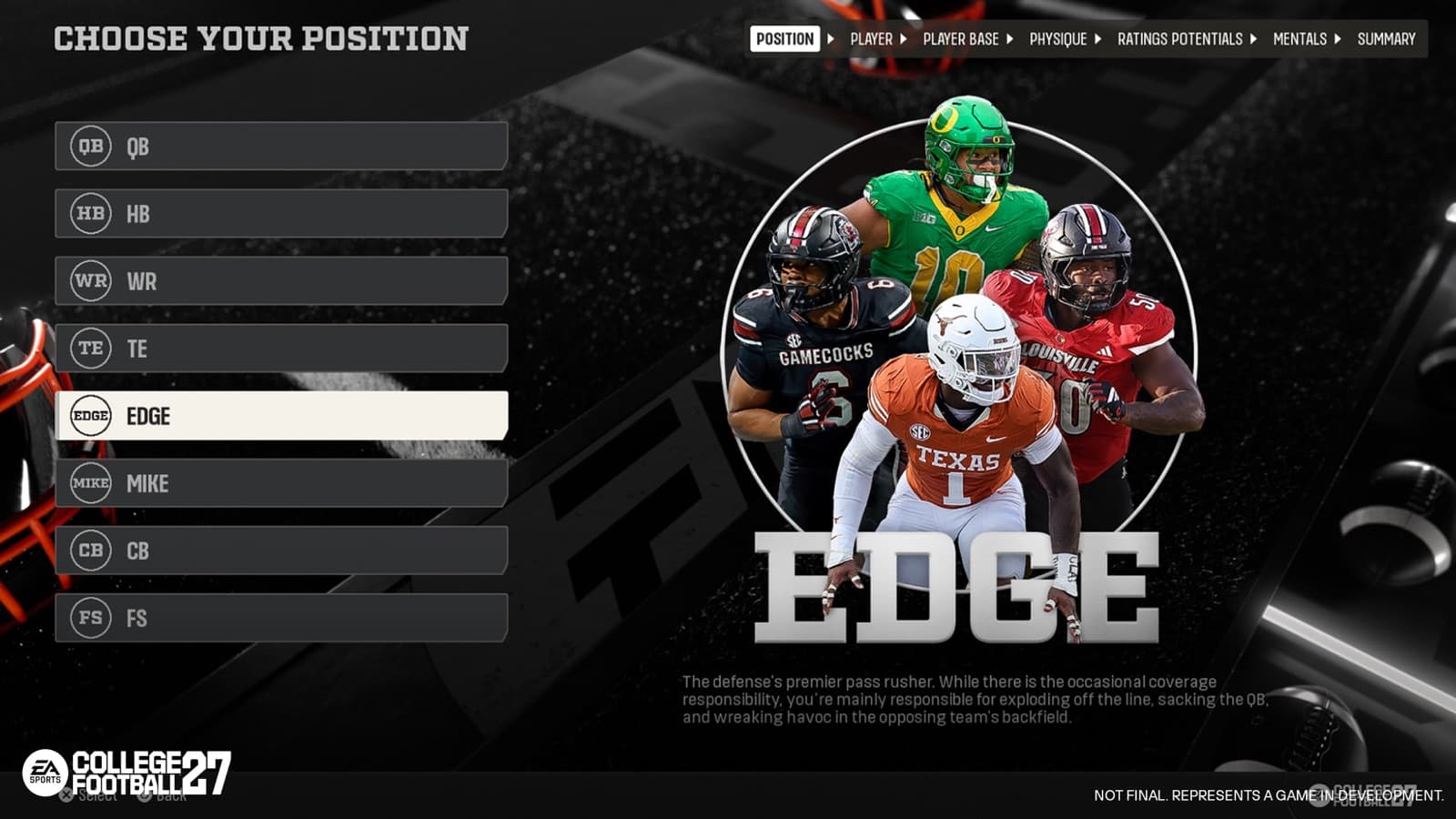
Official Road to Glory position-selection capture. Official pre-release development capture; the live interface may differ.
What EA has confirmed about the position list
EA's Road to Glory deep dive explicitly identifies Tight End, Edge Rusher, and Free Safety as three new playable positions in College Football 27. The official FAQ uses the shorter Safety label while describing the new options. The deep dive also discusses existing-role examples such as quarterback decisions, running back and wide receiver moves, and cornerback coverage, but it does not present those examples as a complete position menu. This guide therefore does not invent a full list beyond what the cited first-party pages verify.
The most useful choice is not automatically the position with the easiest highlight. Per-play grading is designed to recognize role-specific actions, including blocks, pressure, coverage positioning, reads, and tackles. Our recommendation is to choose according to the work between highlights. If you enjoy route and blocking responsibilities, consider Tight End. If snap timing and pass-rush wins appeal to you, consider Edge Rusher. If reading the whole field and limiting deep plays sounds satisfying, consider Free Safety.
Tight End: combine receiving with physical work
EA describes Tight End as capable of stretching the field, working the seams, creating matchup problems, or leaning into the physical side of the role as a run blocker. Road to Glory grading can recognize a tight end for blocking work rather than only receptions. Position-specific practice can also include open-field blocking, where angles, leverage, and timing help spring a teammate. Those systems make the role broader than a pass-catching target.
Our suggested build question is whether you want receiving separation, contact strength, or a balanced identity. Physique affects the physical attribute limits available to the player, while Max Potential determines how much of that possible ceiling the career can reach. A larger body can open different physical strengths but can make movement development more expensive. Do not copy a measurement simply because it looks traditional. Move the physique controls, watch the live caps, and keep enough potential in the attributes that serve both halves of your intended role.
Edge Rusher: win the rep before chasing the sack
Edge Rusher is built around disrupting the offense, attacking tackles, and pressuring the quarterback. EA also confirms a position mechanic called Jump the Snap, which uses the right trigger to time the snap and gain an early advantage. High school objectives can teach pass-rush moves such as swims and bull rushes, while per-play grading can recognize winning a rep or affecting the quarterback even when the result is not a sack.
That grading detail changes the recommended mindset. Rather than selling out on every down, learn which assignment, rush lane, and move the play demands. Our recommendation is to use practice as a timing lab: establish a dependable get-off, then add the physique and potential that suit either speed, power, or a blend. Maxing one attractive attribute at creation can consume a large part of the shared potential pool. Preserve enough ceiling for the supporting tools that turn an initial advantage into consistent pressure.
Free Safety: value positioning before turnovers
EA presents Free Safety as a back-end defender who can cover from sideline to sideline, erase explosive plays, and create turnovers when the ball is in the air. Practice examples for cornerbacks and safeties include one-on-one coverage work, staying connected to receivers, and competing at the catch point. Gameday grading is intended to help a safety understand correct positioning, pursuit angles, and mistakes that allow a big play.
Our recommendation is to build for the snaps that never become interceptions. Choose a physique whose movement caps support the space you expect to cover, then allocate Max Potential to the attributes that keep the player in position before investing heavily in a single highlight trait. In games, treat a prevented deep completion or correct angle as a successful rep when the grading system agrees. Chasing the ball outside the assignment can create the explosive play the role is supposed to remove.
Let physique define possibilities, not your entire identity
Road to Glory links position, height, weight, and body type. Position sets the available height range, selected height changes the available weights, and weight then controls available body types. The creation screen updates physique-driven attribute caps as those settings move. EA's examples describe the tradeoff generally: larger or heavier athletes can have more room for strength and physicality, while smaller or lighter athletes can have more room for speed, acceleration, agility, or quickness.
Physique caps are not final ratings. Max Potential determines how much of the physical ceiling can actually be developed, and future Skill Points are still required to reach it. Our suggested process is to test the physical extremes first, note which essential cap changes, then move back toward a balanced measurement until the tradeoff fits the role. Finally, use the creation summary to inspect strengths, weaknesses, potential Physical Abilities, and attribute caps before confirming. This prevents a cosmetic choice from silently undermining the playstyle you intended.
Plan Max Potential and abilities around repeatable actions
A custom player's attributes begin at a base value and draw from a shared Max Potential pool. Raising an already high attribute costs more, and costs also reflect how important the attribute is to the position. During the career, Skill Points improve individual attributes up to those caps. Physical Ability upgrades remain tied to attribute requirements. Mental Abilities are selected at creation and tied to the Academics, Leadership, and Brand meters; they can deactivate when the related meter falls too low.
Our recommendation is to map the build backward from three repeatable actions. A Tight End might prioritize a route action, a catch or movement action, and a block. An Edge Rusher might connect get-off, a chosen rush style, and finishing. A Free Safety might connect range, coverage control, and tackling. These are planning examples, not official archetype recipes. After identifying the actions, invest potential in the attributes and ability requirements that serve them, then make sure the weekly meters needed by chosen Mental Abilities are realistic to maintain.
Use practice and grading to validate the choice
Road to Glory includes team drills and position-specific drills, and practice performance affects XP, Coach Trust, and Coach Happiness. Gameday grading then reports how the coach views the player's own actions on each snap. Progression is granular, so Skill Points can raise individual attributes instead of only broad groups. Together, those systems provide feedback on whether the position and build feel right before a full career has passed.
Use the first practices as a validation period. Our suggestion is to ask three questions: Do you understand the assignment? Do you enjoy the ordinary successful rep? Does the build's current limitation feel developable within its caps? If the answer is no, restart early rather than expecting one elite rating to change the role's basic responsibilities. If the answer is yes, let practice medals and clear per-play feedback guide the next individual upgrade. A position choice lasts because its normal work is satisfying, not because its rare best play makes a good highlight.
- Choose Tight End for a receiving-and-blocking workload.
- Choose Edge Rusher for snap timing, rush technique, and pressure creation.
- Choose Free Safety for coverage range, angles, and deep-field control.
- Treat these as recommendations, then confirm the feel in practice.