Direct answer
Road to Glory progression uses a connected career loop: earn XP through practice, goals, and on-field performance; protect the Fitness and Leadership factors that modify progression; then spend Skill Points on individual attributes up to Max Potential. Difficulty and Wear and Tear affect pace, while Legacy can affect the ceiling. Review the full career state at the end-of-season portal checkpoint.
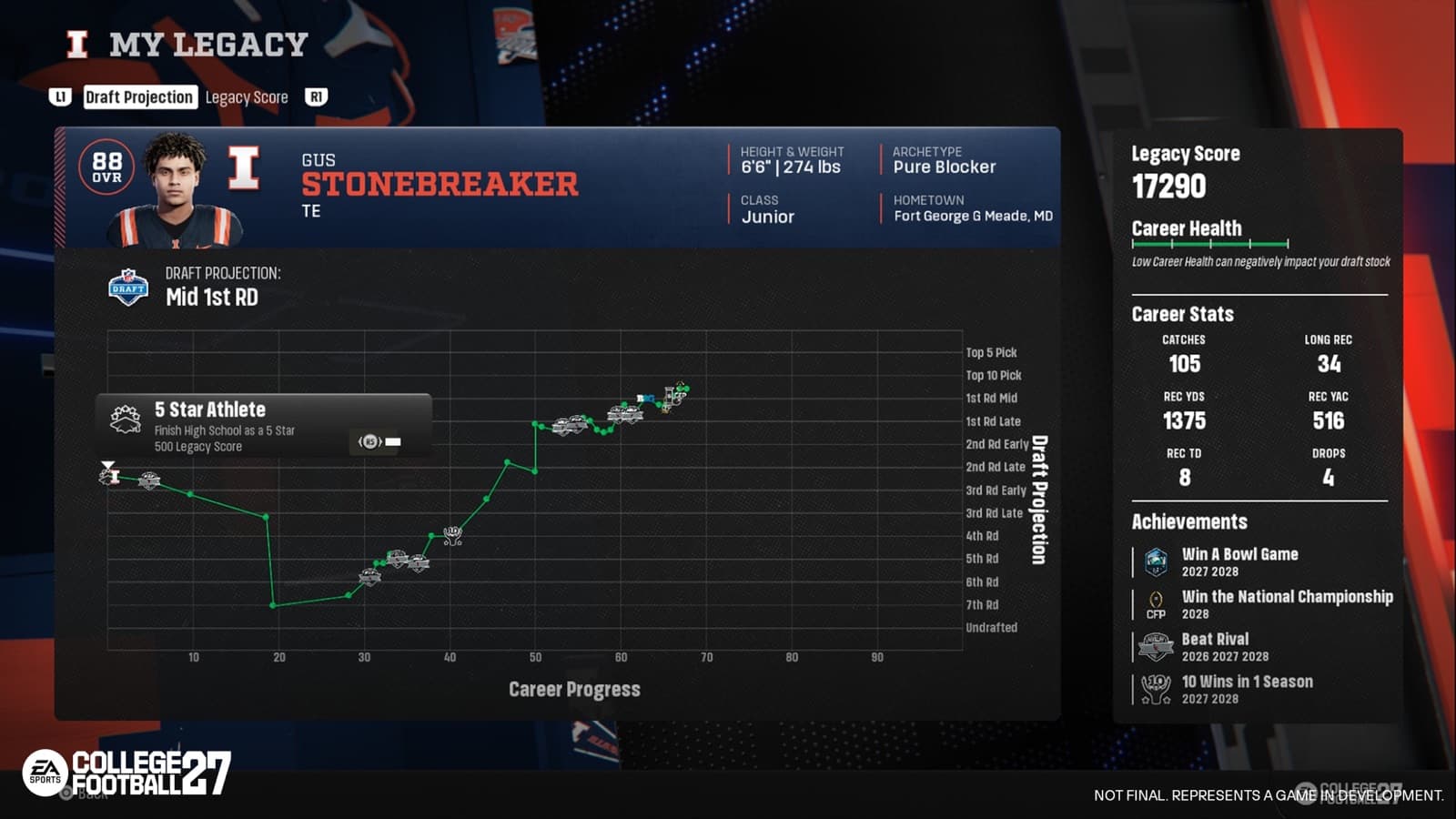
Official Road to Glory progression capture; the athlete, statistics, projection, and Legacy Score are illustrative sample data. Official pre-release development capture; the live interface may differ.
Map the official XP sources before spending
EA Help identifies three ordinary XP sources in Road to Glory: practice, completing goals, and performance on the field. XP produces levels, and leveling awards Skill Points that can improve attributes and abilities. The development deep dive makes the same loop more specific: practice is the main off-game source of progression, while gameday performance supplies the other recurring path. Weekly training is not a direct XP purchase in College Football 27, so progression should be read across the full week rather than reduced to one menu action.
EA also confirmed in its July follow-up that standalone Road to Glory XP sliders are not returning. The stated progression structure considers difficulty, weekly decisions, Fitness, NIL deals, Wear and Tear, Legacy Score, scholarship bonuses, and on-field performance. That means two careers with similar box scores can move at different rates because the surrounding management choices differ. It also means a slow week is not proof that a build is broken; check practice, weekly meters, difficulty, health settings, and the current career stage before drawing that conclusion.
- Practice, completed goals, and on-field performance are confirmed XP sources.
- Leveling converts accumulated XP into Skill Points.
- Weekly management and career context can modify the pace around those sources.
- Do not infer an exact XP formula when the official pages do not publish one.
Use practice to build XP and Coach Trust
Practice is both a development route and a standing check with the coaching staff. College Football 27 assigns a drill each week from a pool that EA says includes more than 50 new team and position-focused drills. The medal earned in that drill affects XP, Coach Trust, and Coach Happiness for the week. Practice matters for a reserve trying to earn a role and for a starter trying to keep developing, so its value is broader than the rating increase shown after one session.
Coach Trust opens practical opportunities. EA Help says higher trust can unlock audibles, additional playbook choices, a better depth-chart position, and the opportunity to enter a Position Battle. Those are career access benefits, not a promise that every good practice produces an immediate promotion. Depth-chart movement still belongs to the larger career state, and the official pages do not provide a universal medal count for reaching a particular role.
- Open the assigned weekly practice and read its football situation before the first rep.
- Complete the drill with attention to the position action being graded.
- Record the medal and the resulting XP, Coach Trust, and Coach Happiness changes.
- Use the next game to test the same assignment under live conditions.

The milestone path is an original visual metaphor; the guide text documents the verified Road to Glory systems.
Balance the Weekly Agenda, Fitness, and Leadership
The Weekly Agenda covers the off-field demands of the college career. EA Help lists Academics, Leadership, Health, Fitness, and Brand, while the deeper feature explanation also connects weekly choices to recovery and active Mental Abilities. Energy spent in one area is energy not spent elsewhere, so the screen is a recurring prioritization step rather than a separate side activity. Academics and health still matter even when the immediate goal is faster ratings growth.
For progression specifically, EA's July follow-up states that Fitness and Leadership both affect the rate at which progression XP is earned. Keeping them high can accelerate XP, while allowing them to fall can slow it. The August 6 title update added the current Leadership and Fitness XP Modifier values to the XP Progression Week Summary, giving players a direct place to inspect those current effects instead of relying only on memory or community estimates.
- Review the XP Progression Week Summary for current Fitness and Leadership values.
- Keep enough energy for the game and for required academic or health management.
- Treat Brand and other opportunities as choices within the same limited week.
- Reassess after scenarios or injuries change the cost of the original plan.
Understand difficulty and Wear and Tear modifiers
Difficulty is part of the progression model. EA says a performance achieved on a higher difficulty creates a higher progression opportunity because the challenge is greater. The same explanation also makes an important limit clear: a player can still reach the maximum rating on Freshman over the course of a career. Higher difficulty can affect pace, but it is not an official requirement for completing development.
Wear and Tear is another progression lever. When Wear and Tear is disabled, the game adjusts the XP modifier because one of the mode's management challenges has been removed. Career wear and tear can also influence Draft Projection, linking weekly body management to the larger career evaluation. The sources do not provide a fixed conversion table for every difficulty and health combination, so this guide does not invent one.
Spend Skill Points inside Max Potential
XP earned from practice and games leads to Skill Points. College Football 27 lets you spend those points on individual attributes rather than only broad skill groups, but each attribute can advance only to the player's Max Potential cap. Upgrade costs depend on the attribute, its importance to the position, the current rating, and the player's measurements. Physical Abilities also have attribute requirements, so an upgrade can affect both a rating and access to an ability path.
Max Potential was established during creation and is distinct from physique. Physique defines a physical limit, while the allocated Max Potential defines how much of that possible range the career can initially reach. An attractive number on the physique screen therefore does not guarantee that normal progression can reach it. Check the player upgrade screen before spending so you understand the cap, cost, linked ratings, and ability requirements currently shown for that athlete.
- Open the upgrade screen and inspect the current cap for the target attribute.
- Check the Skill Point cost and any linked attribute movement.
- Review the requirements of the Physical Ability you intend to support.
- Spend only when the change reinforces the role you actually play.
Use Legacy to read the long-term ceiling
Legacy Score records the impact of the college career through performance, achievements, awards, championships, rivalries, records, and major decisions. It is related to progression but is not the same as XP. XP and Skill Points develop attributes inside the current limits; Legacy can satisfy thresholds tied to higher Overall ceilings. Max Potential describes what the build could become, while Legacy helps prove that the career has earned access to higher stages of that potential.
The August 6 update added a redesigned Legacy Score and Draft Projection screen, corrected several transfer and display issues, and added an end-of-season action item leading to that screen. Use that current view as the authoritative career snapshot. A single productive game can add to the story, but the official design describes Legacy as the shape of a career, not a repeatable one-play farm.
Treat the portal as a progression checkpoint
Every season ends with a coach meeting that evaluates performance, development, team role, leadership, Coach Happiness, and off-field decisions. The school also reviews the next annual scholarship bonus. Depending on the career state, the coach may encourage the player to remain, enter the NFL Draft, or explore the Transfer Portal. Entering the portal reveals offers from other schools so the next destination can be chosen from the opportunities actually presented.
The portal is therefore a progression checkpoint, not an automatic cure for a slow month. The August 6 update fixed transfer and scholarship issues and added new recruiting scenarios, but a destination still needs to fit the player's role and development needs. Our recommendation is to compare the current and proposed depth-chart positions, scholarship bonuses, remaining Max Potential, Coach Trust path, Fitness burden, and active ability support before deciding.
- Read the full coach meeting and next scholarship package.
- Capture current progression, role, health, and Legacy information.
- Compare only the portal offers the game actually presents.
- Choose the option that solves a defined career constraint rather than reacting to one game.