Direct answer
Dynasty recruiting in College Football 27 moves from Open to Top 5, Top 3, Verbal Commit, and Hard Commit. Use preseason to scout because scholarship and NIL offers begin in Week 0, then manage weekly influence, school fit, pipelines, and limited Dynasty Points until signing. A verbal commitment can still flip among the recruit's Top 3; only a hard commitment closes the normal recruiting battle.
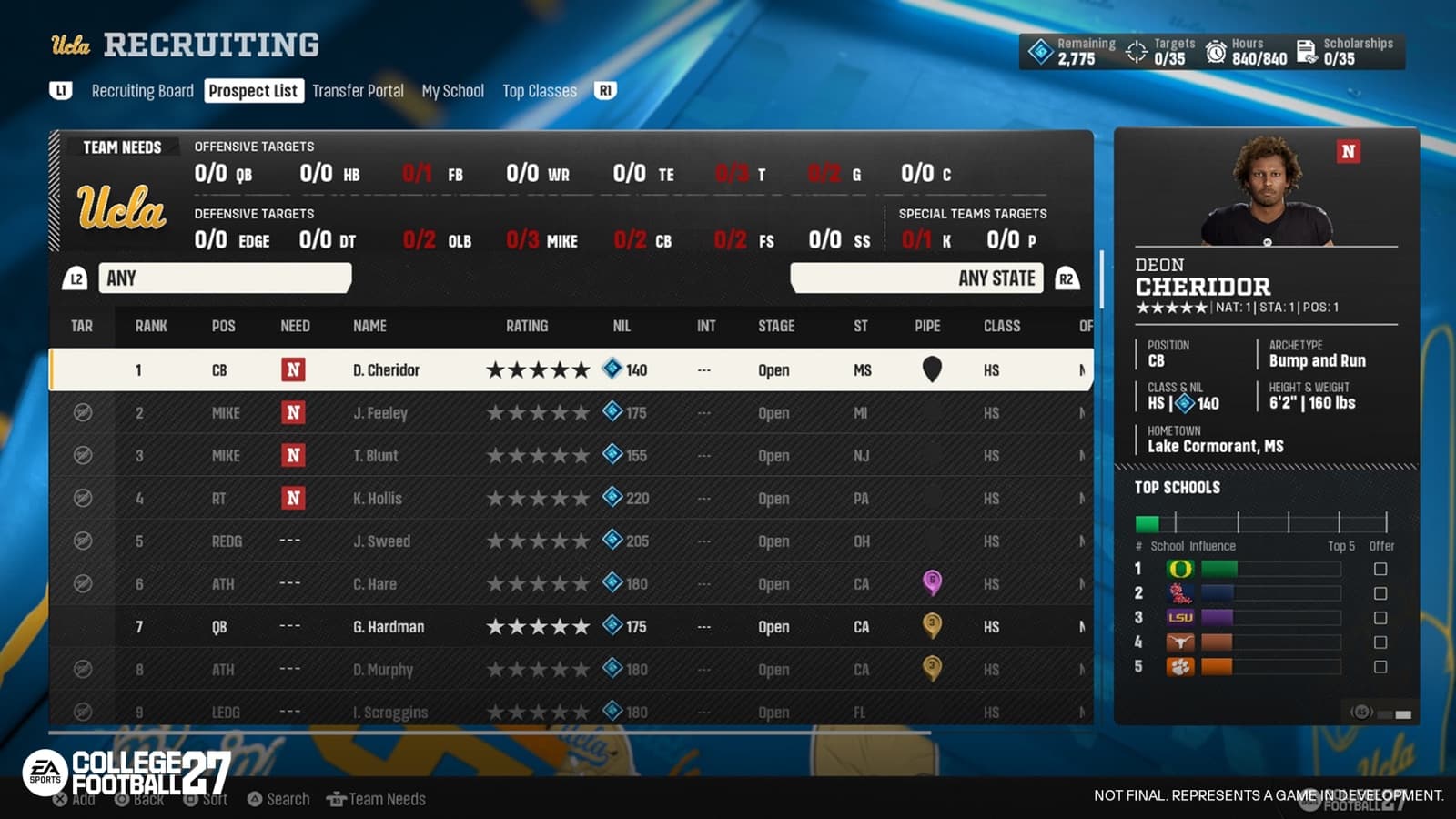
Official Dynasty recruiting capture; names, rankings, budgets, and interest levels shown in the sample screen are not live guide data. Official pre-release development capture; the live interface may differ.
Understand the new recruiting stages
College Football 27 moves a prospect through Open, Top 5, Top 3, Verbal Commit, and Hard Commit. EA removed the previous Top 8 stage, creating more time before a recruitment narrows while making the Top 3 especially important. A verbal commitment is no longer the finish line. The committed school gains an influence advantage, but the other schools remaining in the Top 3 can continue recruiting until the player hard commits.
That structure changes how a board should be read. Open indicates a broad race. Top 5 and Top 3 show that options are narrowing. Verbal Commit identifies the current leader with a bonus, not an irreversible signing. Hard Commit ends the active contest under the normal flow. The official deep dive notes that a hard-committed recruit will sign unless a dealbreaker is violated before signing day, so maintaining the conditions that attracted the player still matters.
Use preseason for scouting and board construction
EA says scholarships can no longer be offered during preseason in College Football 27. Preseason is dedicated to scouting, and scholarship offers begin in Week 0. That separation gives the coach a defined evaluation window before an offer commits Dynasty Points and attaches NIL to the scholarship. Use it to identify prospects who fit the roster and remove attractive names that do not solve a real need.
Start with roster context. Review graduating talent, position depth, development timelines, scheme, and the number of realistic targets you can manage. The deep dive identifies playing time, scheme, relationships, pipelines, My School strengths, and other fit signals as relevant parts of roster building. It also warns that offering without enough evaluation can leave a program overpaying for a player who does not fit.
- Audit the current roster and identify urgent and future position needs.
- Scout the highest-priority fits during preseason.
- Compare scheme, pipeline, school strengths, playing-time path, and dealbreakers.
- Enter Week 0 with a ranked offer plan instead of offering every prospect.

Anonymous markers visualize a recommended planning workflow, not real recruits, rankings, or schools.
Evaluate fit before chasing stars
A recruiting ranking is useful context, but it is not the whole decision. College Football 27 connects recruiting to program identity and resources. Pipelines can strengthen a school's position in a region, My School grades describe program advantages and weaknesses, and playing-time or scheme considerations can change how sensible a target is. A highly rated prospect who conflicts with a dealbreaker or has no credible role may require resources that would help the roster more elsewhere.
Review the prospect and the program together. Ask whether the player fills a current need, whether the scheme creates a real role, whether the school has advantages that support the pitch, and whether the NIL expectation is sustainable after the player arrives. EA explains that an NIL commitment can carry forward and grow as a player develops, earns a larger role, or wins awards. A recruiting win therefore has future retention consequences.
Make scholarship and Recruiting NIL offers
Beginning in Week 0, a scholarship offer shows the prospect's expected NIL amount and the program's current offer. Offering above expectation improves interest and weekly influence; offering below expectation applies a penalty. EA allows an offer up to twice the expected amount for the largest weekly influence bonus. The tradeoff is important: an above-expectation offer raises the amount that prospect expects from your school and establishes a higher floor for later decisions.
Dynasty Points attached to the offer are deducted immediately. If the prospect commits elsewhere or is removed from the recruiting board, EA says those points are refunded. While the player remains a target, however, the commitment reduces the points available for staff, facilities, other recruits, transfers, and roster retention. That makes an aggressive offer a budget decision rather than a free influence button.
- Expected NIL is the comparison point shown for the prospect.
- Higher offers can add weekly influence but increase future expectations.
- Lower offers preserve points but can reduce weekly influence.
- Committed offer points remain unavailable until refunded or the recruitment resolves.
Manage influence and offers every week
Recruiting is a weekly process. EA allows NIL offers to be adjusted after the scholarship has been made. Increasing an offer can support a late push; reducing it preserves points but can create negative influence when the new amount falls below the expectation your program established. The Recruiting Board shows the amount offered to each prospect, and the Dynasty Blueprint includes a recruiting NIL view for reviewing expected amounts and current offers across the board.
A useful weekly review begins with stage changes. Identify targets who entered the Top 5 or Top 3, verbal commitments that require protection or pursuit, and prospects whose position no longer justifies the budget. Then compare influence direction and available points before changing an offer. Do not react to every small movement by automatically raising NIL. That recommendation is a risk-control strategy, not an official rule.
- Check recruiting-stage changes and new commitments.
- Review expected NIL, current offers, and remaining Dynasty Points.
- Protect priority leads and identify races that need a deliberate push.
- Remove or reduce low-priority targets only after considering the influence penalty.
- Confirm that recruiting spend still leaves room for the rest of the Blueprint.
Protect verbal commitments and pursue flips
When a recruit verbally commits, the leading school receives a bonus influence multiplier based on factors that include pipeline strength, Team Prestige, and Proximity to Home. The other two schools in the prospect's Top 3 can continue recruiting. If one passes the committed school before the hard-commit threshold, the player can decommit and the recruitment reopens among those Top 3 programs without the verbal-commitment bonus.
Once the prospect reaches Hard Commit, the normal influence contest is over. If signing day arrives while the player is still verbally committed, EA says the player automatically hard commits and signs with that school, assuming the documented dealbreaker condition does not disrupt the commitment. That means the leader's job is to finish, while the chasing school must decide whether the remaining opportunity is worth continued resources.
Account for transfers and current tuning
Transfer recruiting belongs to the same roster-building system but uses a condensed window. EA says transfer motivations are already visible, so programs do not need to uncover them in the same way as high-school prospects. The emphasis shifts to quickly understanding fit, presenting the program, and making the right NIL offer before the player commits elsewhere. Preserve enough budget and roster flexibility if transfers are part of the plan.
Recruiting behavior has also received post-launch tuning. The July follow-up described adjustments to how CPU teams compete for highly rated recruits, retain targets after offers, and handle late-cycle prospects. EA noted that some changes would become most visible in a next season or new Dynasty. The August update added further recruiting-board and generator fixes. These notes matter because an older save and a new save may not expose every change in the same way.
- High-school recruiting has a longer discovery and commitment flow.
- Transfer recruiting uses a shorter window with motivations already shown.
- Post-launch tuning can affect CPU competition and recruiting-board behavior.
- Review the latest official update before applying an old workaround.