Direct answer
There is no universal best College Football 27 offensive playbook. EA currently highlights Army, Ohio State, Florida International, South Carolina, and UL Monroe, but they solve different problems: option structure, experienced passing, deep shotgun combinations, balanced spread answers, or explosive shotgun plus quarterback runs. Choose by personnel and the concepts you can execute, then retest after gameplay updates because blocking, protection, coverage, and playbook content can change.
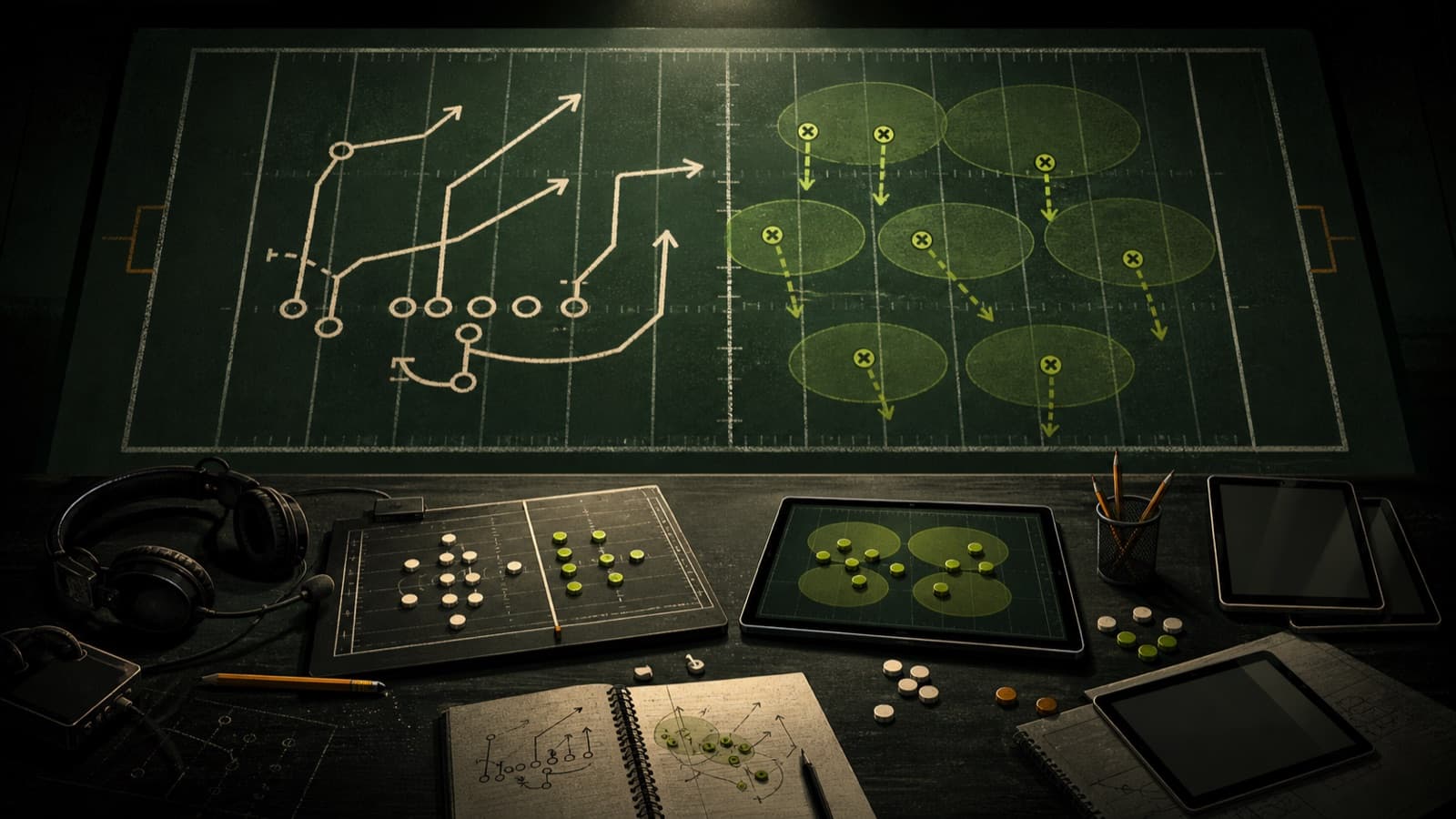
The route and zone marks are an original scheme illustration, not a reproduced official playbook.
Treat the highlighted five as a current shortlist
EA's official tips page currently highlights Army, Ohio State, Florida International, South Carolina, and UL Monroe. That page is a useful official shortlist, not proof that one book is optimal for every roster, opponent, skill level, or patch. College Football 27 also changes through title updates. The August 6 update adjusted blocking, quick-pass protection, play-action protection, coverage logic, and other interactions that can alter how familiar concepts perform even when an offensive book's menu is unchanged.
Start by rejecting the idea that the displayed order can choose for you. A concept only has value when the roster can staff it and the user can make its core read. Army's option identity asks different questions from Ohio State's passing structures; Florida International's layered shotgun combinations are not the same job as South Carolina's all-field spread; UL Monroe combines explosive pass shapes with designed quarterback runs. The best fit is therefore conditional.
Audit personnel and decision load first
Before comparing formations, describe the offense in football terms. Does the quarterback make option reads comfortably, threaten the defense as a designed runner, or win primarily with timing throws? Can the line sustain longer-developing protection, or should the call sheet emphasize quick answers? Which receiver wins outside, who can work through traffic, and whether a tight end or receiving back creates the clearest matchup? These questions are our evaluation framework, not hidden game ratings supplied by EA.
Next, define the decision load the user wants. Option football can reduce the number of route reads while increasing the importance of mesh and pitch decisions. Layered dropback concepts can present multiple answers but demand protection recognition and progression discipline. RPOs combine a fast box or leverage read with ball security. A playbook that exposes five theoretical answers may be worse for a player who can execute two of them consistently.
- Quarterback: option comfort, designed-run value, and passing progression load.
- Protection: quick-game need versus time for deeper combinations.
Choose Army for a committed option identity
EA describes Army as the premier option-oriented choice in its current five, built around a deep Flexbone menu. The highlighted concepts include Triple Option, Veer Option, Rocket Toss, fullback dives, and quarterback runs. The book also adds Gun Flexbone Tight Slots, which brings RPOs, designed quarterback runs, wheel routes, play action, and read-option ideas into a shotgun presentation. It is the most distinct identity in the official shortlist.
Choose it when the roster and user are prepared to make option decisions repeatedly rather than treating one option call as a novelty. The official page connects the book with option football and clock control; it does not promise automatic possession wins. A wrong read can still create a loss, and an opponent can still force the offense away from its preferred picture. Our recommendation is to learn the give, keep, and pitch decision on one family before expanding.
Compare Ohio State with Florida International
Ohio State is EA's highlighted experienced-user passing option. Its featured formations include Gun Tight Doubles, Gun Trips TE Flex, and Bunch X Nasty, with route structures that can attack man or zone through crossers, posts, motion, flood concepts, and vertical stress. EA notes that many stock calls may need only minor changes. That makes the book attractive to a user who wants sophisticated passing answers without rebuilding every concept before the snap.
Florida International is the deeper shotgun specialist in the current shortlist. EA highlights Gun Bunch, Gun Bunch Strong Nasty, and Y-Off Trio Close Weak, with layered horizontal and vertical combinations that include flood, trail, return, deep posts, and other zone-stressing shapes. The practical difference is emphasis: Ohio State offers a polished experienced passing menu across several compact structures, while FIU leans into shotgun breadth and layered route combinations.
Our recommendation is to choose Ohio State when formation familiarity and quick access to man-and-zone answers matter most. Choose FIU when the user wants to live in shotgun and is willing to manage deeper route spacing and progression timing. Neither conclusion is universal. Test protection time, the second read, and the checkdown with the actual roster, because a concept that looks complete on the play-art screen may ask more of the line or quarterback than the team can supply.
Compare South Carolina with UL Monroe
South Carolina represents a complete modern spread in EA's current group. Gun Trips HB Weak is a centerpiece, blending quick passes, quarterback runs, RPOs, flood and sail structures, bubbles, read option, posts, and underneath answers. EA emphasizes how its spacing can help identify coverage. The book suits a caller who wants to challenge the entire field while keeping a family of fast, visible answers available from a recurring formation.
UL Monroe emphasizes explosive shotgun formations and useful stock concepts with less dependence on extensive hot routing. EA highlights Gun Trips TE concepts such as China, Dagger, Texas, angle routes, posts, and drags; Gun Bunch Wide supplies posts, wheels, motion, vertical stretches, and deep flood ideas. Designed quarterback calls including QB Blast and QB Wrap add a second dimension. It combines passing variety with quarterback-run flexibility.
Our recommendation is South Carolina for a user who values RPO and quick-game continuity across an all-field spread plan. UL Monroe is the stronger candidate when explosive stock passing shapes and designed quarterback runs are the desired center. That is a practical comparison, not a permanent ranking. If the quarterback is not a credible runner, verify whether UL Monroe's remaining pass menu still beats the alternative rather than valuing unavailable parts of the book.
Run a controlled playbook trial
Compare candidates with the same small test. Select one early-down call, one answer against pressure, one third-and-medium call, one red-zone call, and one short-yardage call from each book. Use the same team and defensive looks where possible. The official sources do not define this trial; it is our suggested way to reduce selection bias. Success means the user understands the read and the personnel can execute it, not that one rep produced a touchdown.
During each trial, limit pre-snap edits. The goal is to discover what the book provides in stock form before judging how much customization it needs. Then allow one or two deliberate adjustments and see whether the concept becomes clearer or only more complicated. Note the protection, first answer, outlet, and failure condition. A playbook with a recognizable answer after the defense changes the picture is easier to carry into a full game plan.
- Pick five common situations and find one stock answer for each.
- Test the same team and comparable defensive pictures across candidates.
- Select the smallest call sheet that remains understandable when the first answer is removed.
Revalidate the choice after updates
Playbooks are patch-sensitive even when their formation list does not visibly change. On August 6, EA adjusted blocking assignments, receiver-versus-defensive-back block outcomes, chip-and-release behavior, quick-pass blocker depth, play-action protection, pass rush, and multiple coverage checks. Those changes can alter the timing and risk of option, RPO, quick-game, and deeper passing calls. The same official update also listed several gameplay issues still under investigation rather than presenting them as fixed.
After an update, retest the five-call trial instead of relying on memory. Pay particular attention to the calls whose success depended on a protection depth, block interaction, coverage match, or hot-route response named in the notes. Our recommendation is to change the call sheet only after reproducing a meaningful difference in the current build. A single failed rep does not establish that the book is obsolete.
As of this guide's August 11 review, the five names above remain EA's currently highlighted offensive shortlist. That statement is a dated source snapshot, not an evergreen competitive tier list. Recheck the official tips page and current title-update notes whenever the game changes, then rerun the personnel and practice tests before calling any playbook the best fit for a specific roster.