Direct answer
Choose a College Football 27 defensive playbook by matching one of EA's six styles—Man, Man Pressure, Shell, Zone, Zone Pressure, or Multiple—to your personnel and the calls you can adjust before the snap. Confirm the book has fronts for the offenses you face, coverage answers you understand, and pressure that does not depend on one fragile setup. Then retest after updates: the August 6 patch changed coverage, fronts, pass rush, and selected defensive playbooks while leaving other issues under investigation.
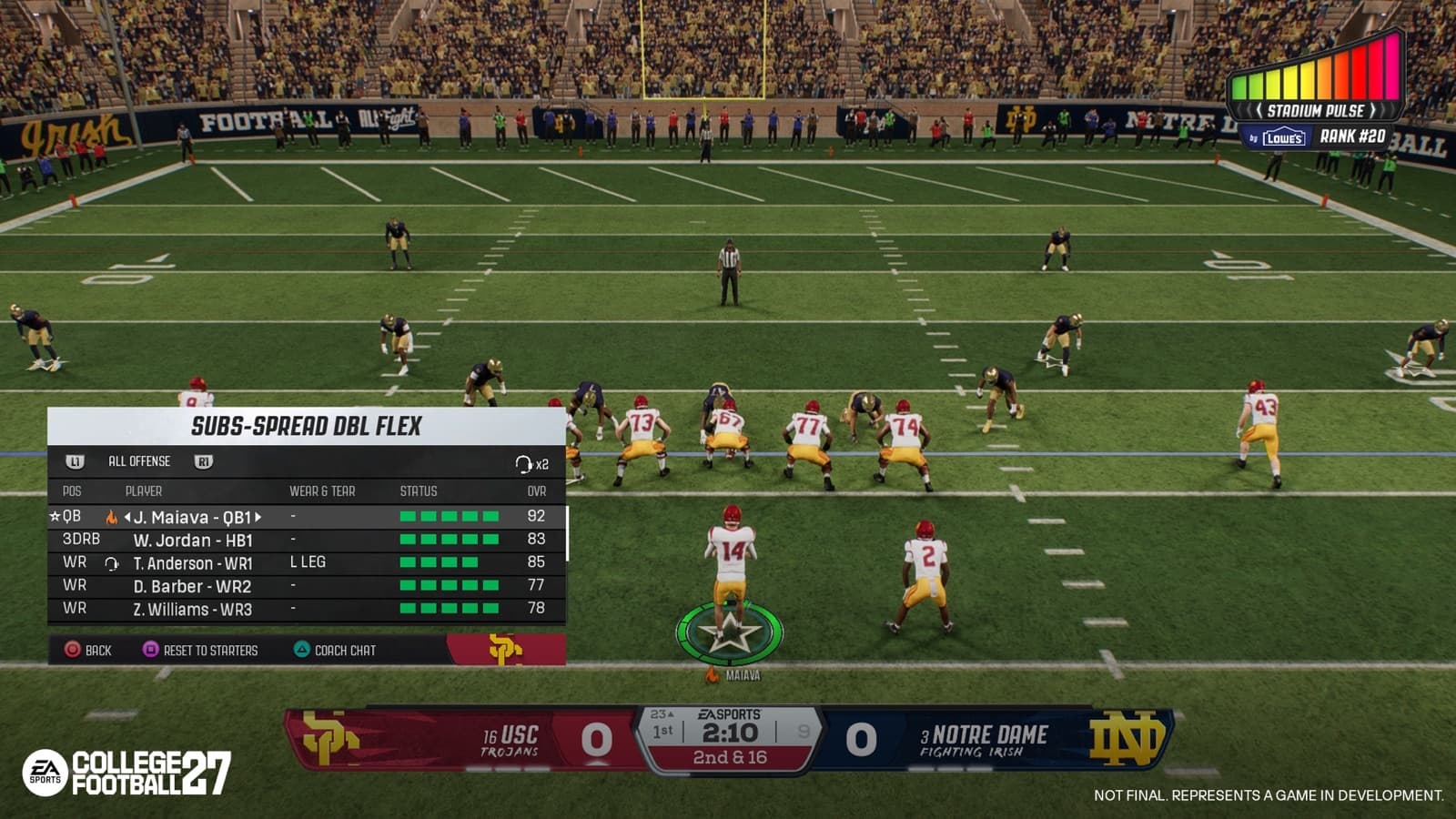
Official College Football 27 pre-snap formation and offensive personnel-substitution capture; the score, ratings, and lineup are illustrative. Official pre-release development capture; the live interface may differ.
Verified style matrix · S11 / S23 / S24 / S28
Choose a book by responsibility
EA organizes the defensive library around six identities. The useful choice is the one your personnel can staff and you can explain before the snap.
| Style | Primary idea | Audit before adopting |
|---|---|---|
| Man | Direct matchup coverage. | Corner depth and leverage help. |
| Man Pressure | Pressure paired with man coverage. | Quick-throw answer and isolated matchup. |
| Shell | Split-safety structure and disguise. | Run-fit cost and match rules. |
| Zone | Zone integrity as the base. | Short, intermediate, and deep landmarks. |
| Zone Pressure | Pressure with zone rules behind it. | Rush source and vacated area. |
| Multiple | Several fronts and coverage families. | Personnel transitions and user workload. |
Start with the six official defensive styles
College Football 27 expands the defensive library from nine playbooks to 31, with 22 new books, and maps 138 teams to six official styles: Man, Man Pressure, Shell, Zone, Zone Pressure, and Multiple. EA explains that the identity affects how a book is organized and called. Man Pressure surfaces pressure-man concepts early, Shell emphasizes split-safety structure, and Zone Pressure combines simulated pressure with zone integrity behind it.
The other labels still describe a decision, not a guaranteed result. Man centers man-coverage answers; Zone centers zone structures; Multiple gives access to varied identities and fronts. Those concise descriptions follow the official style names and broader deep-dive framing, but they do not mean every play in a book uses one coverage. Open the actual formation and concept list before treating the label as complete evidence.
- Man: prioritize direct matchup coverage tools.
- Man Pressure: pair man coverage with a pressure identity.
- Shell: work from split-safety structure and disguise.
- Zone: preserve zone structure as the primary answer.
- Zone Pressure: create pressure while retaining zone rules behind it.
- Multiple: carry several structures when personnel and user knowledge support them.
Fit fronts and personnel to the roster
EA added 16 defensive formations, including 3-3-5 3 High Over, 4-2-5 3 High, 3-4 Grizzly, Nickel Double Mug, Wide Jack, Single Mug Dime, new Tite and Under fronts, and pressure structures intended to answer modern spread offenses. Existing packages also received personnel corrections: Dollar now uses four safeties and two cornerbacks, while CB1 alignment was standardized to match WR1 more consistently. These details make the position inventory part of playbook selection.
Audit the front before the coverage menu. Count interior defenders who can hold blocks, edges who can rush or contain, linebackers who can cover space, and defensive backs who can fill the required safety and corner roles. That is our recommended evaluation, not an official ratings threshold. A formation name can imply a structure, but the current depth chart determines whether its responsibilities are credible.
- List the defense's playable interior, edge, linebacker, corner, and safety depth.
- Open candidate books and record the formations that fit that inventory directly.
- Reject any core package that requires unavailable depth at a critical position.
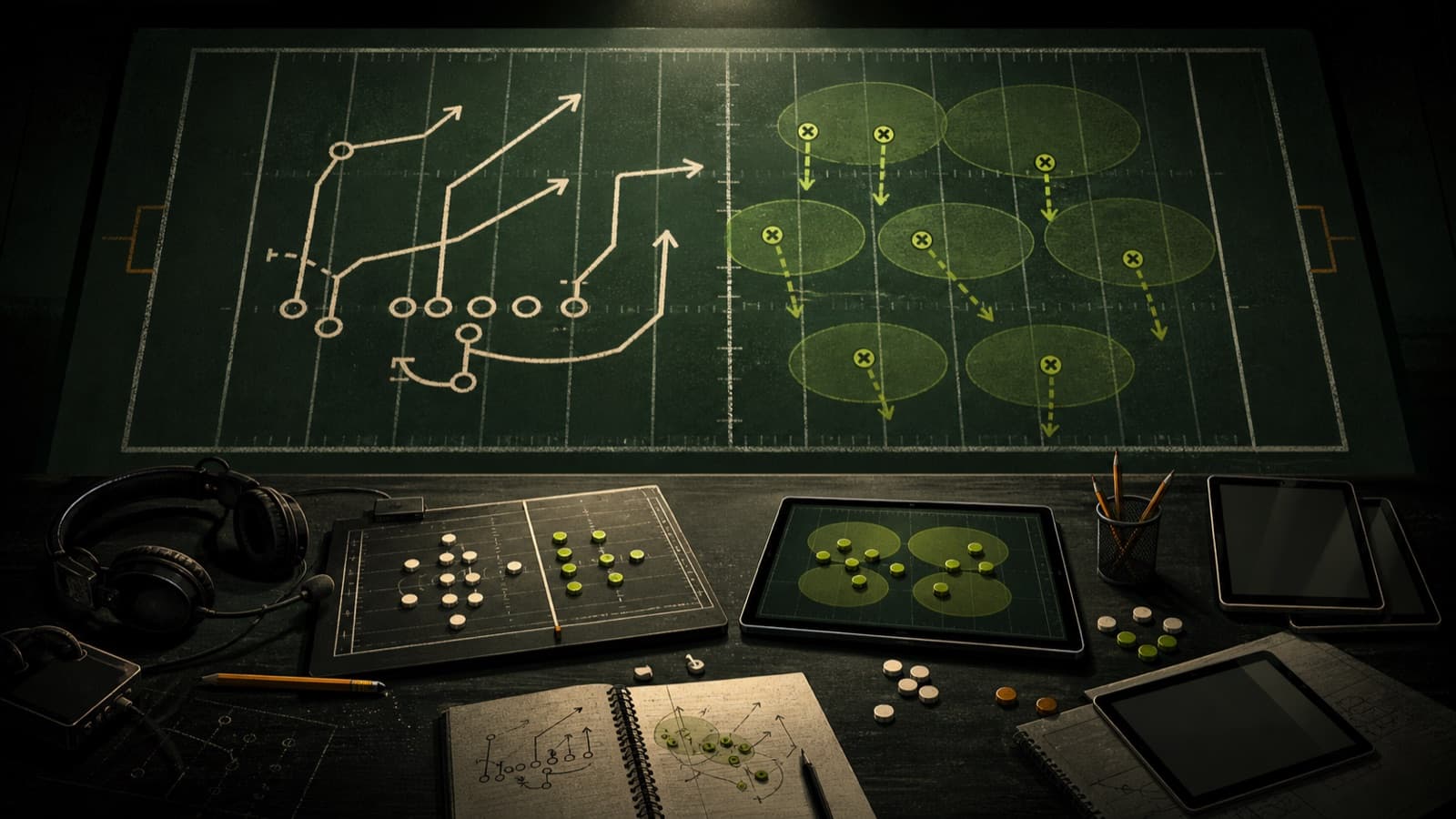
The route and zone marks are an original scheme illustration, not a reproduced official playbook.
Build a coverage menu you can explain
The gameplay deep dive expands coverage controls and logic rather than presenting zone depth as one static slider. Smart Zones offer Aggressive, Balanced, Conservative, Ultra Aggressive, and Ultra Conservative behaviors, and the official description connects those options with playing shorter, assigned, or deeper landmarks. Coverage systems also include checks for concepts such as Cover 3 Match, Quarters, Palms, and Cover 6, along with tools including Look for Work, Plaster, Red Zone Awareness, and Focus.
Choose a base coverage only if you can state who protects the quick throw, who carries vertical stress, and what changes against motion or a compressed set. That explanatory test is our recommendation. Match rules are not interchangeable with spot-drop zone, and an aggressive depth can concede space behind it. A conservative choice can protect deeper routes while allowing easier completions underneath. The call should express a tradeoff you intended.
Add pressure without losing the coverage answer
Pressure belongs inside the defensive style, not outside it. Man Pressure books place pressure-man calls near the center of their identity, while Zone Pressure uses simulated pressure with zone integrity behind it. The expanded formation list includes Double Mug, Single Mug Dime, Wide Jack, and other pressure structures. Those official labels describe available tools; they do not promise a free rusher or guarantee that an offense cannot identify the source.
Our recommendation is to tag every pressure by its coverage cost. Record which defender leaves the fit or coverage, which matchup becomes isolated, and what quick answer the offense may use. Pair the pressure with a companion call from the same picture when possible, then vary the rush rather than telegraphing one setup. Pressure is sustainable when the defense knows the answer if the ball leaves quickly, not only when the rush arrives untouched.
- Name the coverage behind every pressure call.
- Identify the vacated or stressed area before using the call in a game.
- Relearn timing after updates that change stunts, shedding, or protection.
Use audibles and pre-snap adjustments deliberately
An audible changes the selected play before the snap. EA Help states that formation audibles stay within the same personnel grouping: a grouping with three wide receivers can move to another compatible formation using the same combination of players, but it cannot freely substitute a different personnel package through that audible. Defensive playbook improvements also make transitions across fronts and personnel more natural, especially in Nickel, without removing the same-personnel constraint.
Build an audible set around four jobs: a safe coverage, a pressure, a run-aware answer, and a call for the formation picture most likely to break the base plan. That is our suggested structure, not an official four-call prescription. Practice the full input before relying on it online, and verify where each player relocates. A theoretically correct change can fail when the user runs out of time or a defender changes responsibility unexpectedly.
- Confirm that every formation audible retains compatible personnel.
- Assign each audible a distinct situation and purpose.
- Practice the inputs and inspect every defender's new alignment.
- Use saved adjustments only after the underlying responsibilities are clear.
Apply the current August playbook changes
The August 6 title update added Cover 4 Zone, Cover 6 Zone, and Cover 9 Zone calls to selected defensive playbooks. EA describes them as vision-and-break zone presets rather than matching coverages and notes that, like Cover 4 drop, their safeties are not part of the run fit. The same update added 12 Press Quarters calls to the Press Quarters playbook, three blitzes to the 3-3-5 Odd Ghost book, and 4-3 Under Wide to the 4-2-5 Zone Pressure book.
Those additions change the menu, not the need to understand it. Our recommendation is to label the new zone calls clearly so they are not confused with similarly named match concepts. For Press Quarters, examine the new calls one at a time and identify the coverage rule before installing them. For 3-3-5 Odd Ghost and 4-2-5 Zone Pressure, verify that the roster can staff the added pressure or base-front answer without weakening the rest of the plan.
The update also improved several coverage checks and increased CPU coaching variety, while its on-the-radar list still included man-coverage effectiveness, slot defensive backs not always flipping, coverage shells not always being respected, and hurry-up Custom Adjustment resets. A tracked issue is not a confirmed universal failure, and it is not a fix. Use the current official note to interpret a reproducible problem, then retest after the next update.
Validate one compact defensive game plan
Select a candidate by running a controlled script: an early-down run, a spread pass, a compressed or bunch set, a mobile-quarterback look, third-and-medium, red zone, and hurry-up. Find one primary call and one adjustment for each situation. This seven-situation script is our recommendation, not an official test. Keep the same roster and comparable offensive looks so the playbook, not a changing matchup, is the main variable.
Score understanding rather than highlights. After each rep, identify the front, coverage, pressure source, user assignment, and intended adjustment. If the explanation changes after the snap because the user did not recognize a check, simplify the call. If one package forces weak personnel onto the field, return to the formation audit. A compact plan with known tradeoffs is more usable than a large book whose calls cannot be distinguished under the play clock.
- Test seven repeatable offensive situations with the same defensive roster.
- State the front, coverage, pressure, and user responsibility after every call.
- Remove calls that depend on unavailable personnel or unexplained checks.