Direct answer
Stadium Pulse is College Football 27's home-field pressure system. Watch the meter on the right side of the screen: a fuller meter signals stronger effects for the visiting team, including distorted play art, missing receiver icons, controller feedback, and unreliable hot routes or audibles. Dynamic Camera Effects can remove screen shake and pulsing camera visuals, but it does not remove the underlying gameplay challenge. Use simpler calls, dependable personnel, and a rehearsed road script.
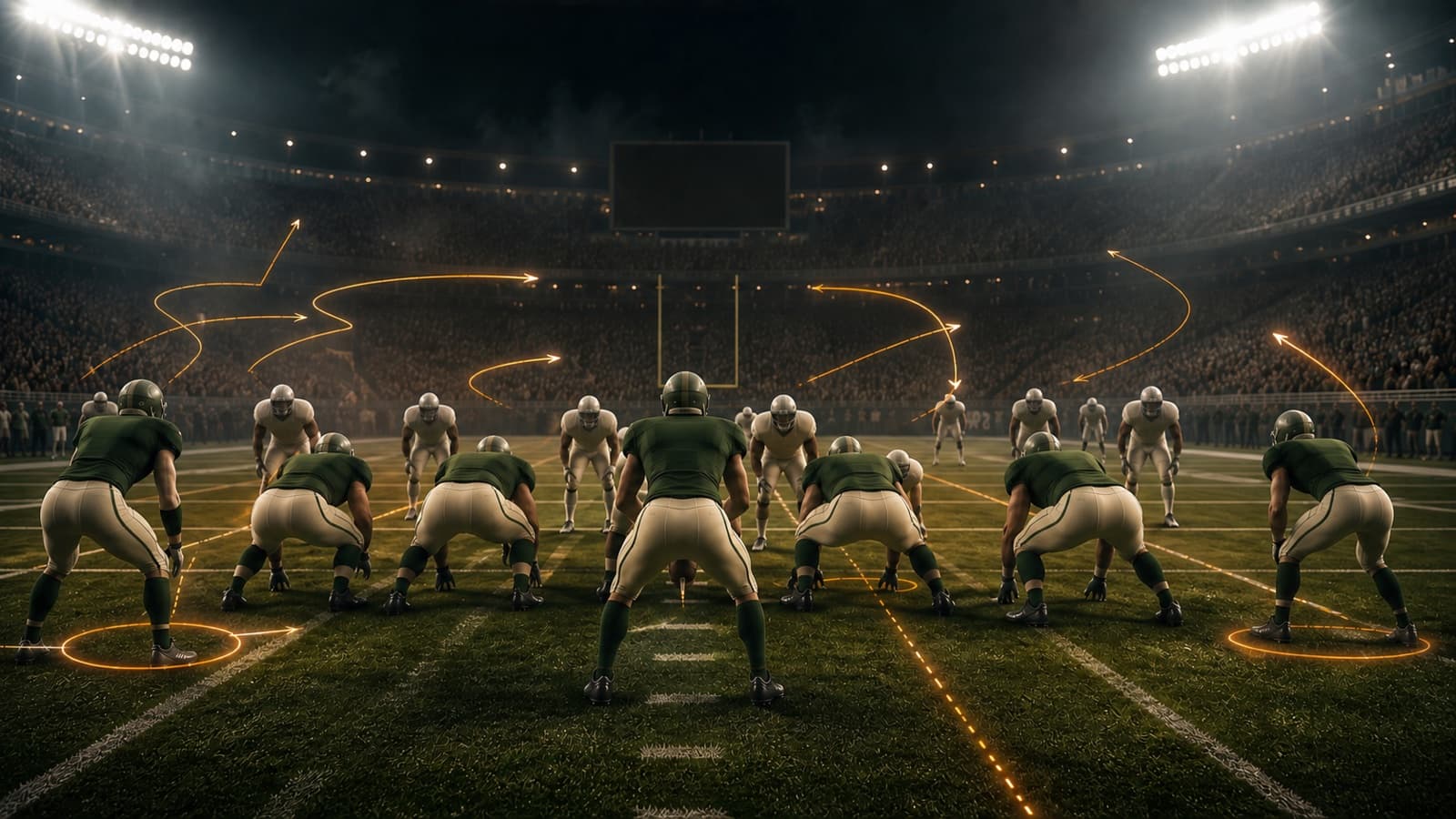
This is an original pre-snap illustration with fictional players and stadium, not official gameplay footage.
Read the Stadium Pulse meter before the snap
Stadium Pulse represents the pressure, momentum, and emotional intensity of playing in a college stadium, with the visiting offense facing the clearest challenge. Its meter appears on the right side of the screen during a game. As the meter fills, the effect becomes stronger. Read it as a live warning that execution conditions are changing, not as a possession counter or a published numerical percentage. EA does not provide a complete formula connecting each bar to a fixed input penalty.
Build a pre-snap habit around that warning. Check the meter before selecting a complex adjustment sequence, then confirm the personnel and primary read before leaving the huddle. A low meter does not guarantee a clean play, and a full meter does not make execution impossible. It tells you that the home-field system has greater influence at that moment. Our recommendation is to reduce the number of decisions you must communicate as the visible pressure rises.
Expect routes, icons, and communication to break down
When Stadium Pulse intensifies, the official Help guide says controller vibration can increase, pre-play routes can become distorted, and receiver icons can disappear. Those presentation changes remove information a visiting player normally uses to confirm assignments. The system can also affect button inputs and play diagrams. Memorize the primary receiver's icon and the shape of the core concept before the snap rather than trying to reconstruct every route after the play begins.
Hot routes and audibles can fail or may not register as expected because the quarterback cannot communicate clearly through the crowd. That makes repeated menu input a poor substitute for a prepared answer. If an audible does not register, return to the original play's safest read rather than assuming another rapid attempt will succeed. Stadium Pulse creates uncertainty around communication, so the fallback should already exist inside the original call.
Connect intensity to home-field strength carefully
The louder and more passionate the fanbase, the stronger Stadium Pulse can become. EA Help says venues belonging to one of the top 50 toughest teams display a Stadium Toughness Ranking under the meter. That label provides venue context while the meter shows the current in-game pressure. A ranking and a live meter are related to hostile home-field conditions, but they are not interchangeable measurements and the official pages do not publish a conversion from rank to meter fill.
Performance can change the immediate atmosphere. The official guidance says a visiting offense can temporarily quiet the crowd and reduce Stadium Pulse effects by gaining 20 or more yards on one play. That is a documented threshold, not a guarantee that every later snap stays calm. Treat the resulting window as a chance to run the offense cleanly, because the crowd can become a factor again as the game changes. Do not chase an explosive play if the risk is unreasonable for the situation.
Use Dynamic Camera Effects for visual comfort
Dynamic Camera Effects is available through the Accessibility area of the main menu. Turning it off removes screen shake during Stadium Pulse moments and the pulsing camera effects described by EA Help. This can make the screen more comfortable or the visual field easier to process. It is an accessibility and presentation choice, not a competitive bypass, and players should use the setting that lets them read the game most effectively.
The underlying Stadium Pulse challenge remains when the visual effect is disabled. EA explicitly notes that turning off visual and auditory effects does not remove the gameplay difficulty or core effects. Routes, icons, communication, and other pressure-related problems can therefore still matter. Verify the setting before a game rather than pausing mid-drive, then practice once with the chosen presentation so the absence of camera motion is not mistaken for the absence of Stadium Pulse itself.
Build a compact hostile-road offense
EA recommends basic, high-confidence plays such as short passes and runs when Stadium Pulse is strong. Running backs are not affected by disappearing receiver icons or route confusion, making the run game and backfield touches useful answers when passing information becomes unreliable. This does not mean call a run on every pressured snap. It means keep at least one concept whose execution does not depend on multiple visible receiver prompts or a long chain of pre-snap communication.
Player traits can also matter. Higher awareness or composure can reduce vulnerability to crowd noise and miscommunication, and the official example identifies quarterbacks with the Headstrong Mental Ability as more resistant to negative Stadium Pulse effects, helping hot routes and audibles remain reliable. Check the players actually available on your roster rather than assuming every quarterback has that ability. Our recommended road menu is one run, one short completion, one pressure answer, and one shot reserved for a favorable look.
Manage each away drive as a communication problem
Open the drive with calls the offense can execute before you learn how strongly the venue is affecting communication. In the huddle, identify the formation, primary read, outlet, and one condition that would make you abandon the play. At the line, check the meter and defensive shell. If the original call remains viable, snap it without adding unnecessary adjustments. If the defense creates a clear problem, use one rehearsed audible and accept that Stadium Pulse may prevent it from registering.
After the snap, do not stare at a missing icon. Follow the route landmark and progression established before the play, or move to the safe outlet. A successful explosive gain can briefly suppress the crowd, but a routine positive play can still keep the drive manageable. Between snaps, note whether the meter changed and whether the failure came from the read, execution, or communication. That diagnosis is our coaching framework; the documented mechanism is the crowd-driven disruption itself.
Use the official Top 25 as context, not a formula
EA published a Top 25 Toughest Places to Play list on June 22, 2026. That ranked snapshot identifies the venues the publisher presented as the game's most intimidating home environments at launch. The Stadium Pulse Help page separately notes that teams inside a broader top 50 display their Stadium Toughness Ranking under the meter. The Top 25 article therefore provides useful preparation context, while the top-50 label and live meter are the information shown around an actual matchup.
Do not turn the list into an unsupported promise that rank alone fixes the exact strength, duration, or pattern of Stadium Pulse in every game. Updates, momentum, venue, and on-field events belong to the current session. Before a difficult away matchup, practice the opening script with Dynamic Camera Effects set to your preference, memorize two route concepts, rehearse one formation audible available to that personnel, and prepare a simple run. Then use the meter—not a copied ranking number—to manage the drive in real time.
- Check the dated official Toughest Places list for venue context.
- Use the in-game Stadium Toughness label and meter for the current matchup.
- Practice two simple concepts and one valid formation audible before traveling.
- Reevaluate after every major momentum change or explosive play.